When the Expert Disagreed
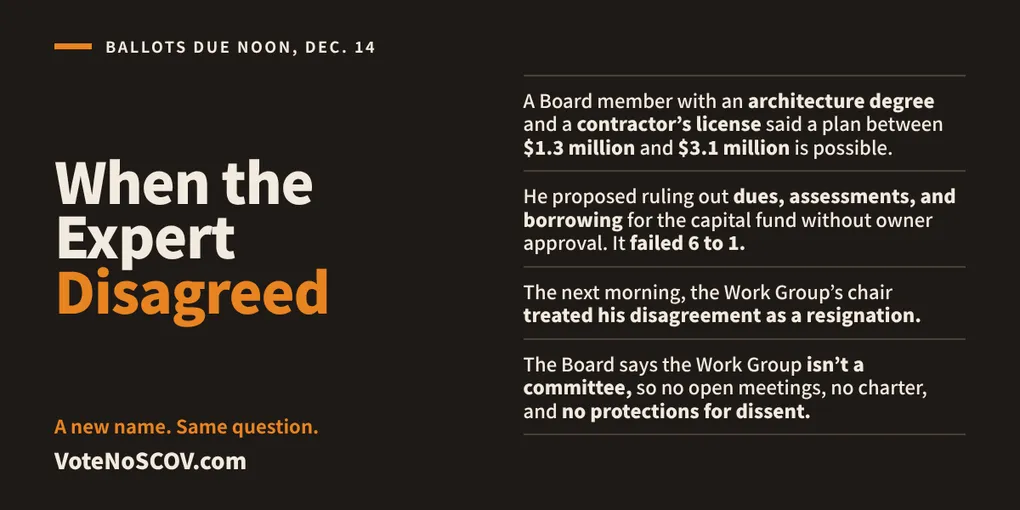
At the November 5 meeting, Director Olson, who has a degree in architecture and is a licensed Arizona general contractor, said a reasonable plan exists between $1.3 million and $3.1 million, possibly done in phases. He served on the Copper Center Work Group and proposed that the Board commit not to use dues, assessments, or borrowing for the capital fund without owner approval. The amendment failed 6 to 1. The next morning, the Work Group’s chair treated his disagreement as a resignation. Because the Board says the Work Group isn’t a committee, none of SCOV’s committee rules apply to it: no open meetings, no charter, and no protections for members who disagree. Owners deserve to hear both views before ballots are due on December 14..
At the November 5 special Board meeting, the Board voted to send the $3.1 million Copper Center spending authorization to owners. One director disagreed, and his reasons are worth hearing.
Director Olson has a degree in architecture, 30 years of construction experience, and an Arizona general contractor’s license. He joined the Copper Center Work Group, called the Work Team in Board reports, to help develop a plan the community could afford.
According to Director Olson, when he joined, the plan he was given was about $1.3 million, roughly what the Board can already spend without a vote. Since then, the scope grew. The proposed Glass Studio alone is now 50% larger than the size the Board previously approved.
He suggested keeping club spaces at their approved sizes, leaving some space unfinished for the future, and doing the work in phases. He said conversations with the clubs convinced him there was room for compromise, and that a reasonable option exists between $1.3 million and $3.1 million.
He also raised financial concerns: the audited financial statements haven’t been released, the asset reserve is underfunded, and the funding plan could change after a Yes vote. So he proposed an amendment: that the Board commit, for the rest of its term including next year’s budget, not to allocate dues, assessments, or borrowing to the capital fund without owner approval. The amendment failed 6 to 1, with only Director Olson voting for it. The Board then approved the ballot initiative without changes, also 6 to 1.
The next morning, the Work Group’s chair emailed him that his “inability to support the Copper Center Renovation Project, as currently designed, also comes with a resignation from the Work Group. It is accepted.” He replied that his comments “were not a resignation,” then formally resigned from the group. He remains on the Board.
Could that happen on a committee? Not easily. SCOV’s committee policy allows a member to be dismissed only for ongoing disruptive behavior, after a meeting with the chair and Board liaison, a written warning, and a written record, with the right to appeal to the Board. But the Board says the Work Group isn’t a committee. It was formed by the General Manager, not the Board, so none of SCOV’s committee rules apply to it: no Board-approved charter, no required minutes, no open meetings with advance notice, and no protections for members who disagree.
Yet this group has a chair, a Board liaison, and weekly meetings, and it has shaped a $3.1 million project and led communication with owners about it. Arizona law (A.R.S. 33-1804) requires that regularly scheduled committee meetings be open to all members, and it doesn’t say a different name changes that. The Board’s own new meeting policy says it shall not use “informal gathering” or “other procedure to circumvent the open-meeting” requirements. If it looks like a committee and works like a committee, owners can fairly ask why it isn’t treated like one.
At the same meeting, the director leading the project said a No vote means “we have to start over.” Director Olson, who helped build the plan, disagrees. A right-sized project is possible.
Owners deserve to hear both views before they vote. Ballots are due by noon on December 14.
A new name. Same question.